
What's Really Driving the Las Vegas Housing Market Right Now
I was recently interviewed by KeyCrew Journal, a national real estate intelligence publication that conducts hundreds of expert interviews every month. Their piece covers something I get asked about constantly: why Las Vegas keeps moving when so much of the country has slowed down. The short answer is migration. The longer answer is more interesting.
Half My Buyers Come From Out of State
That's not an estimate I'm guessing at. It's what I see in my own business, week in and week out. Roughly half of my buyer clients right now are coming from California, Hawaii, Washington, or Oregon. They're relocating for a combination of reasons that, when you add them up, are hard to argue with: Nevada has no state income tax, housing costs significantly less than what they left behind, and they can often buy a larger, newer home here for a fraction of what their previous property cost.
What makes these buyers different from local buyers isn't just their budget. It's their mindset. Local buyers financing a purchase are watching mortgage rates carefully. When rates moved from the high 5% range to above 6.5% in a single month recently, that affected what they could qualify for and what they were willing to commit to. Out-of-state buyers, many of whom sold a home in a high-cost market and are arriving with cash, don't have that concern. About half of the out-of-state buyers I work with pay cash. They're not rate-sensitive. They're looking at lifestyle, long-term value, and what their money can do here compared to where they came from.
The Market Isn't One Market
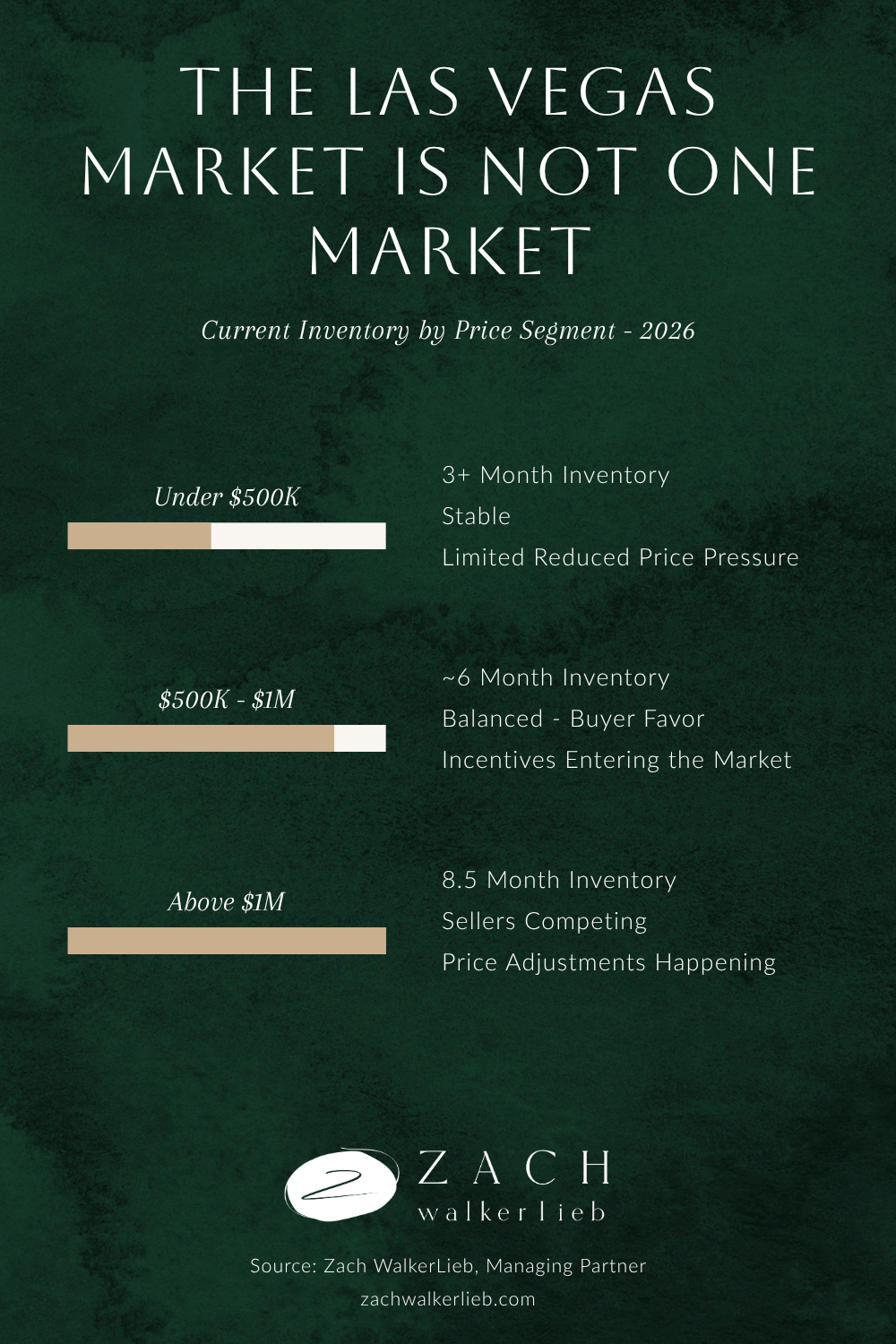
One of the things that frustrates me about national real estate coverage is that it treats "the housing market" as a single thing. It isn't, and Las Vegas is a clear example of why that framing falls short.
Right now, homes priced under $500,000, near the area's median, are showing just over three months of inventory. That's a relatively healthy level. Sales are steady, prices aren't cratering. Move up into the $500,000 to $1 million range and inventory climbs to around six months, which is closer to a balanced or buyer-favored environment. Above $1 million, inventory sits at roughly 8.5 months. Homes in that range are sitting longer, and sellers are having to offer incentives or come down on price to get deals done.
The $1.5 to $3 million range is where I've seen the most significant price adjustments. The buyer pool at that level is smaller, there's more competition among sellers, and the days of listing something in that range and having buyers compete aggressively are largely behind us for now. Broad market headlines miss all of this. Understanding where things actually stand requires looking at specific price bands, not averages.
A Deficit That's Been Building for Over a Decade
People sometimes ask why entry-level inventory in Las Vegas is so tight. The answer isn't complicated, but the scale of it surprises people when they hear the numbers.
Before the 2008 financial crisis, Las Vegas builders were producing between 25,000 and 31,000 new homes a year. After the crash, that number fell to 4,000 to 5,000 annually, and it stayed in the 5,000 to 7,000 range through 2018 or 2019. When you do the math across that period, my estimate is that the valley ended up with a deficit of roughly 100,000 homes. That's not a temporary imbalance. It's a structural shortage that accumulated over more than a decade.
Making it worse: most of what has been built since then has targeted higher price points. Builders like Toll Brothers and Pulte have been constructing homes in the $800,000 to $2 million range and above in Las Vegas. That's good business for them given land and labor costs, but it leaves first-time buyers and workforce buyers with very limited options. Older affordable homes that do come to market disappear quickly, and new entry-level supply simply isn't filling the gap.
What Sellers Need to Understand Right Now
The conversation I have most often with sellers right now is about price expectations. A lot of sellers are still anchored to what properties were selling for in 2021 and early 2022. Those were exceptional market conditions that aren't coming back in the near term. The market has shifted, particularly in the upper price ranges, and sellers who are pricing based on peak comps are sitting on their homes while buyers wait them out.
New construction builders have been quicker to adapt. They're offering closing cost credits, upgrades, and in some cases direct price reductions to keep their sales volumes moving. Resale sellers who are serious about closing are going to need to meet the market where it is, not where it was three or four years ago.
Where the Opportunity Is
For buyers, particularly those who are flexible and prepared to negotiate, this is a real window. In the luxury and move-up segments especially, there is more leverage on the buyer side than we've seen in several years. Sellers are motivated in ways they weren't during the peak years.
For investors, Las Vegas remains a compelling case over the long term. The fundamentals that have always made this market attractive are still in place: migration from higher-cost states, no state income tax, improving infrastructure and amenities, and a chronic supply shortage at the entry level. Communities with strong amenity bases and established demand, including Summerlin, Henderson, Inspirada, Anthem, Mountain's Edge, Providence, Sky Canyon, and Centennial Hills, continue to offer the kind of price stability that long-term investors look for. Summerlin in particular has consistently demonstrated resilience across different market cycles.
The picture is nuanced. It's not a blanket seller's market, and it's not a blanket buyer's market. It depends entirely on what price range you're in and what part of the valley you're focused on. That's what makes knowing this market at a granular level so important.
If you want to talk through what any of this means for your specific situation, I'm happy to help you put it together. Reach out and let's connect.

About Zach WalkerLieb
Zach WalkerLieb is a top Las Vegas real estate agent and Managing Partner of Willow Manor, one of the city's leading luxury real estate teams. With hundreds of millions in closed sales, Zach brings a deep, practical understanding of the Las Vegas housing market, from high-end luxury to the everyday realities shaping neighborhoods across the valley. Beyond real estate, he serves as Chairman of the Board for Habitat for Humanity Las Vegas and as a board member of Keystone Corporation, giving him firsthand insight into housing policy, affordability, and long-term community development. Known for clear thinking, market honesty, and local expertise, Zach writes to help buyers, sellers, and investors make confident, well-informed decisions in Las Vegas real estate.