
Sellers Outnumber Buyers by 86% in Las Vegas: Why the Headline Doesn't Tell the Whole Story
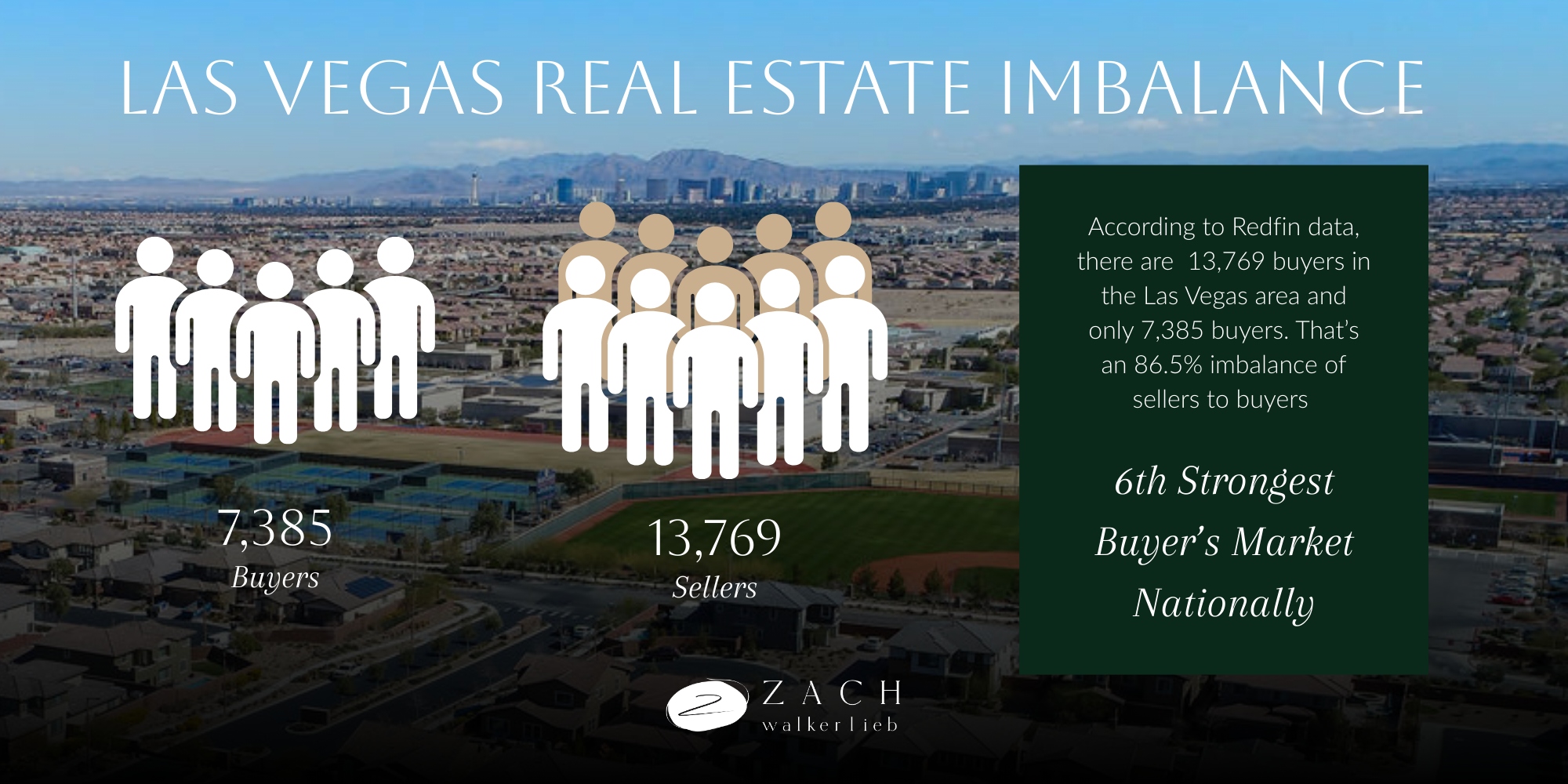
If you've been following Las Vegas real estate headlines lately, you've probably seen the attention-grabbing stat: sellers outnumber buyers by 86.5 percent, making Las Vegas the sixth strongest buyer's market in the country. That sounds dramatic—and it is, in aggregate. But here's what matters more: the Las Vegas housing market isn't one market. It's actually several distinct markets operating under the same skyline, and your experience as a buyer or seller will vary dramatically depending on which price segment you're in.
The Redfin data showing 13,769 sellers competing for just 7,385 buyers tells an important part of the story. But the real insight comes when you break down what's happening at different price points—because that's where strategy gets made and opportunities get found.
The National Context: A Historic Buyer's Market
Let's start with the big picture. Nationally, there are 37 percent more home sellers than buyers, more than double last year's gap and the widest imbalance since 2013, when the housing market was still recovering from the Great Recession. Active buyers have fallen to 1.34 million, the lowest level in Redfin's 12 years of tracking this data. That's even lower than April 2020, at the start of the pandemic.
The reasons are straightforward: stubbornly high home prices, elevated mortgage rates hovering around 7 percent, mounting economic uncertainty, and in some markets, layoffs. Buyers who were ready to compete aggressively in 2021's bidding wars are now taking their time—or stepping back entirely.
The shift is most visible across the Sun Belt, where Las Vegas sits alongside Austin, Nashville, Miami, and several Florida markets as cities that went from pandemic darlings to buyer-advantaged markets. Las Vegas home sales skyrocketed during the pandemic, pushing prices up sharply and making the city one of the hottest markets in the country. Now, after more than a year of 20+ percent inventory increases, the pendulum has swung the other way.
Why Price Point Changes Everything
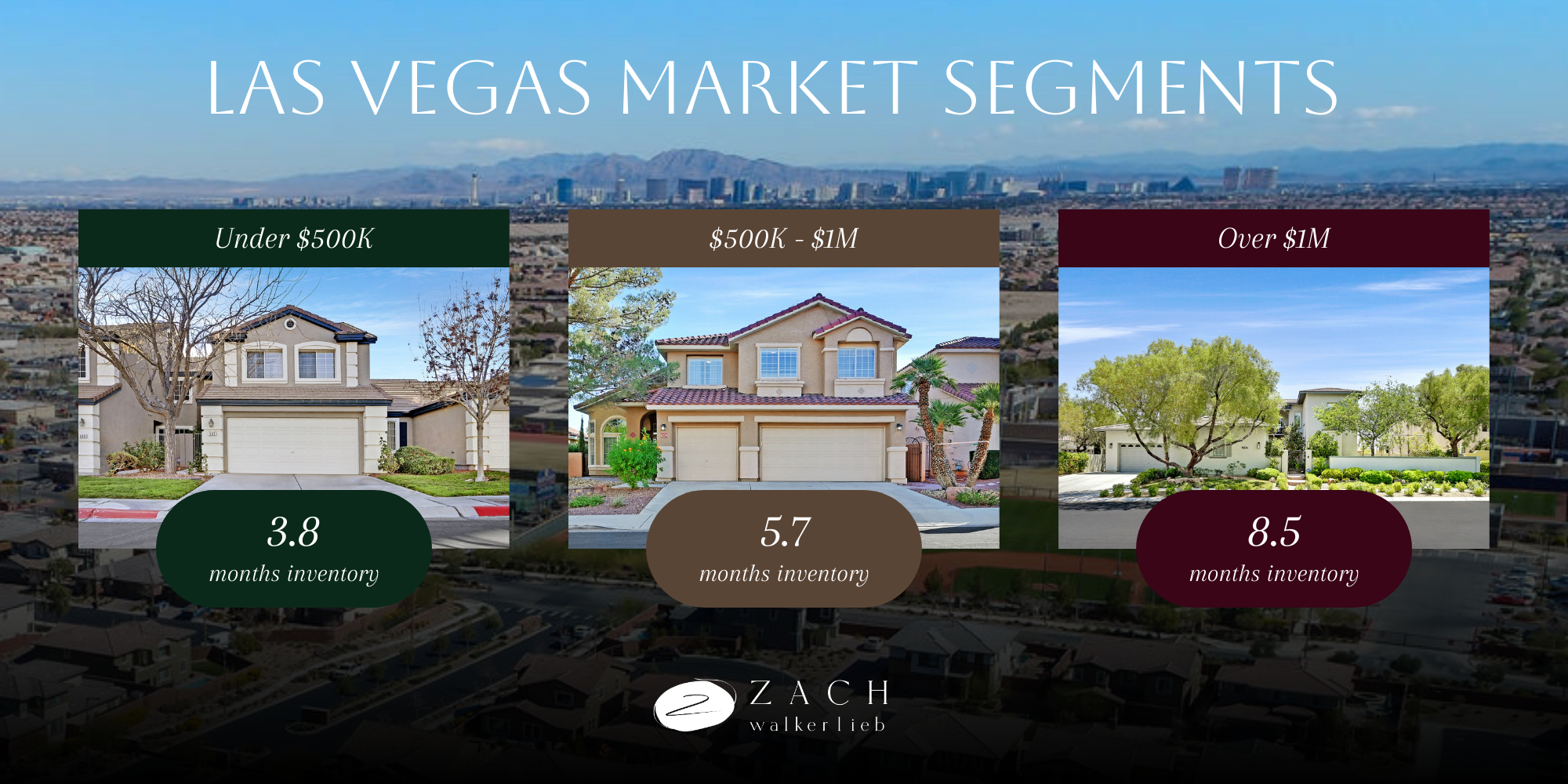
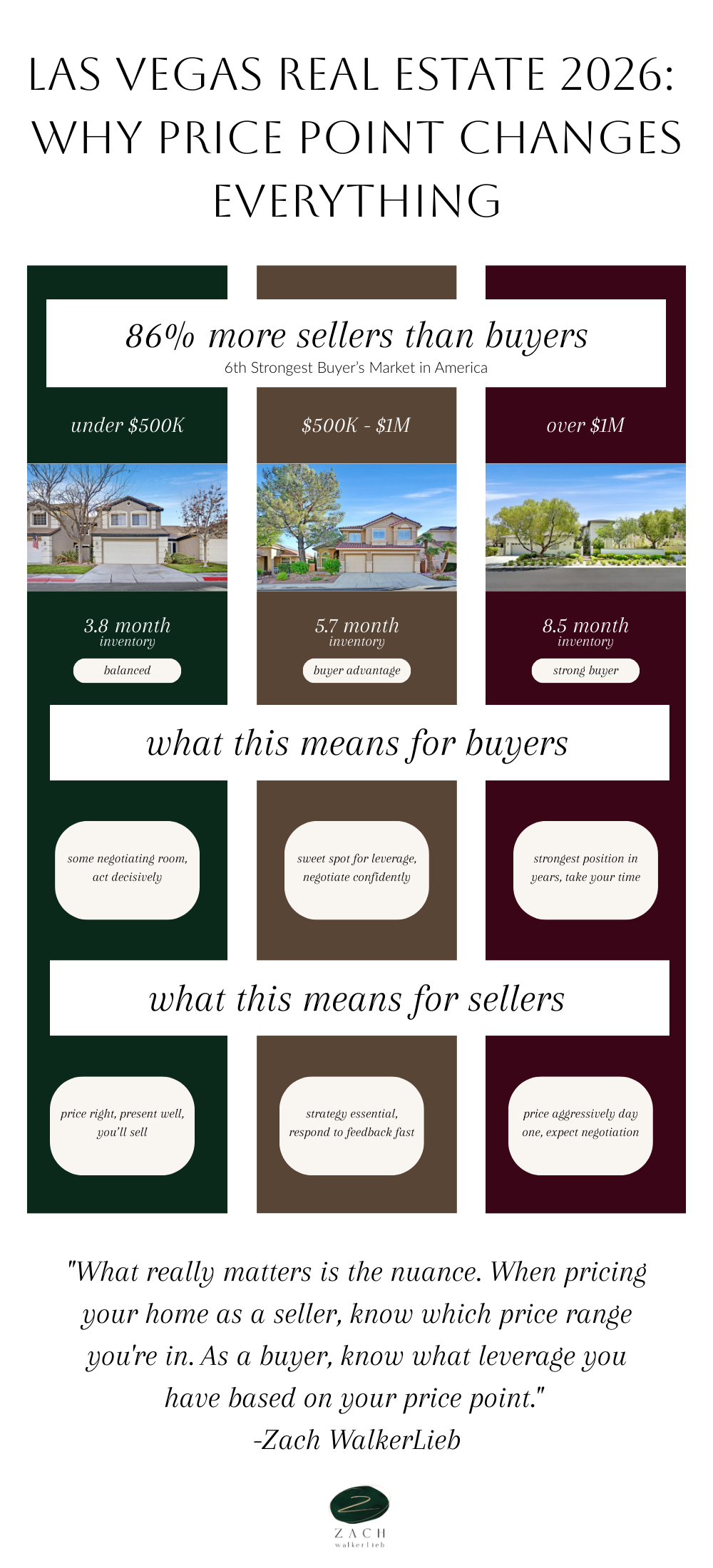
Here's where the headline number—86.5 percent more sellers than buyers—starts to obscure more than it reveals. The Las Vegas market isn't experiencing uniform conditions across all price ranges. The inventory dynamics, negotiating leverage, and time-to-sale metrics vary significantly depending on whether you're looking at homes under $500,000, between $500,000 and $1 million, or above $1 million.
As Zach Walkerlieb, a fourth-generation Las Vegas local and managing partner of Willow Manor, explains: "What really matters about this data is the nuance within it. It's especially important when considering the price range that you're looking at."
Under $500,000: Still Competitive

For single-family homes priced under $500,000, the market tells a very different story than the headline suggests. There's approximately 3.8 months of inventory in this segment—which sits squarely in balanced territory, with a slight lean toward buyers. A balanced market typically ranges between 4 and 6 months of supply; anything under 3 months favors sellers.
What this means practically: if you're a buyer looking in Henderson for a starter home in the $400,000 range, or searching North Las Vegas for family-friendly options under $500,000, you're not walking into a buyer's paradise. You have some negotiating room and more selection than you would have had in 2021 or 2022, but well-priced homes in good condition are still moving relatively quickly.
For sellers in this range: your home will likely sell if priced correctly and presented well, but you won't command the premiums or see the bidding wars that characterized the pandemic market. Realistic pricing based on recent comparables is essential.
$500,000 to $1 Million: The Shift Becomes Clear
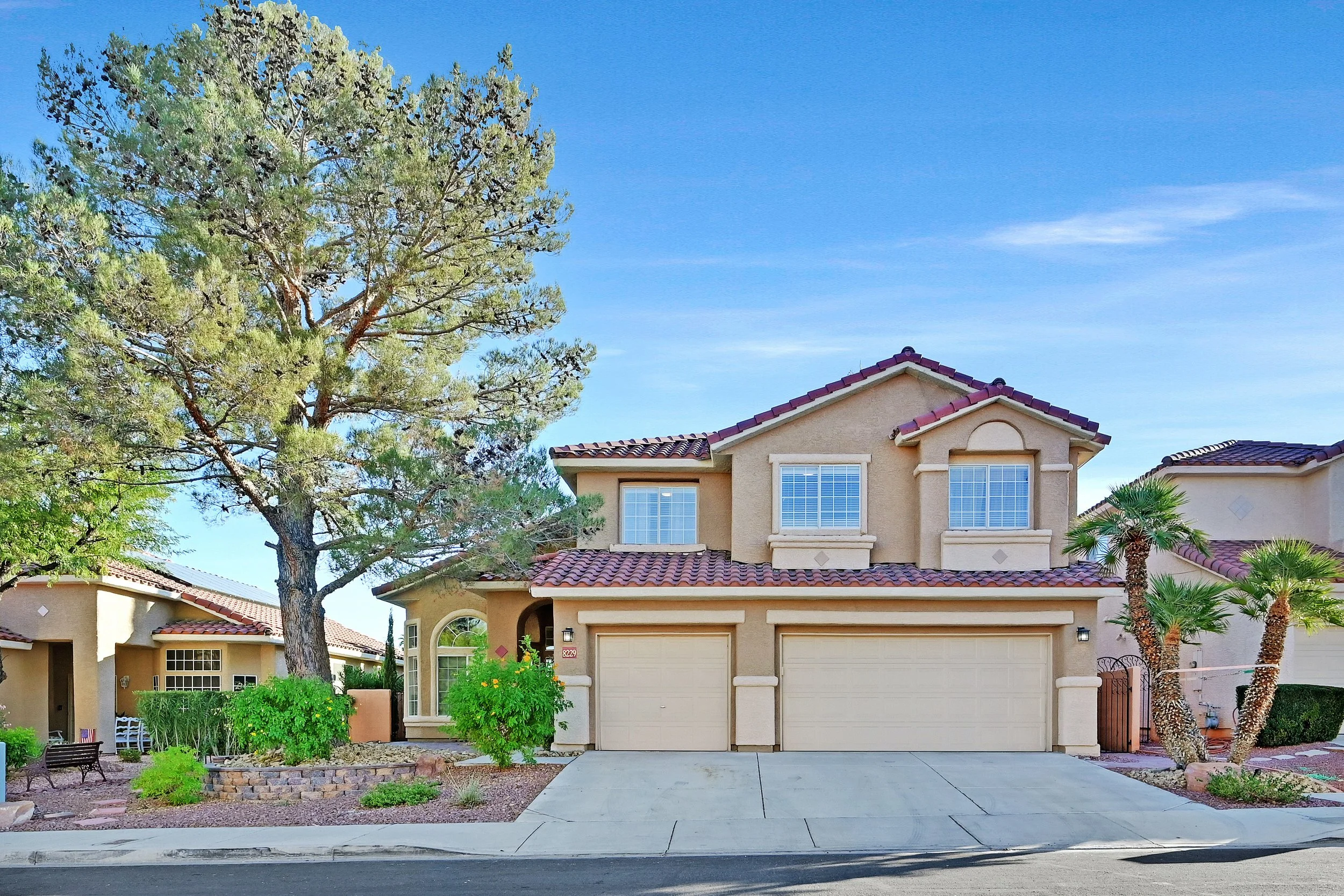
Move up to the $500,000 to $1 million price range—covering much of Summerlin's mid-tier housing, parts of Henderson's established neighborhoods, and Southwest Las Vegas—and the market dynamics shift noticeably. Here, there's approximately 5.7 months of inventory, a significant increase compared to the sub-$500,000 segment.
"There's a significant increase in active inventory versus what's selling each month," Walkerlieb notes. With supply at 5.7 months, this segment has crossed into buyer-advantaged territory.
What this means practically: buyers in this range have genuine negotiating leverage. Sellers who price aggressively or aren't willing to make concessions—whether on price, repairs, or closing costs—will watch their homes sit. Days on market stretch longer here, and the gap between asking price and final sale price tends to be wider than in lower price ranges.
For sellers: this is where strategy matters most. Understanding recent comparables, being realistic about condition and location, and responding to market feedback quickly can make the difference between a 30-day sale and a 90-day listing that ultimately sells for less than if it had been priced right initially.
$1 Million and Above: A Clear Buyer's Market
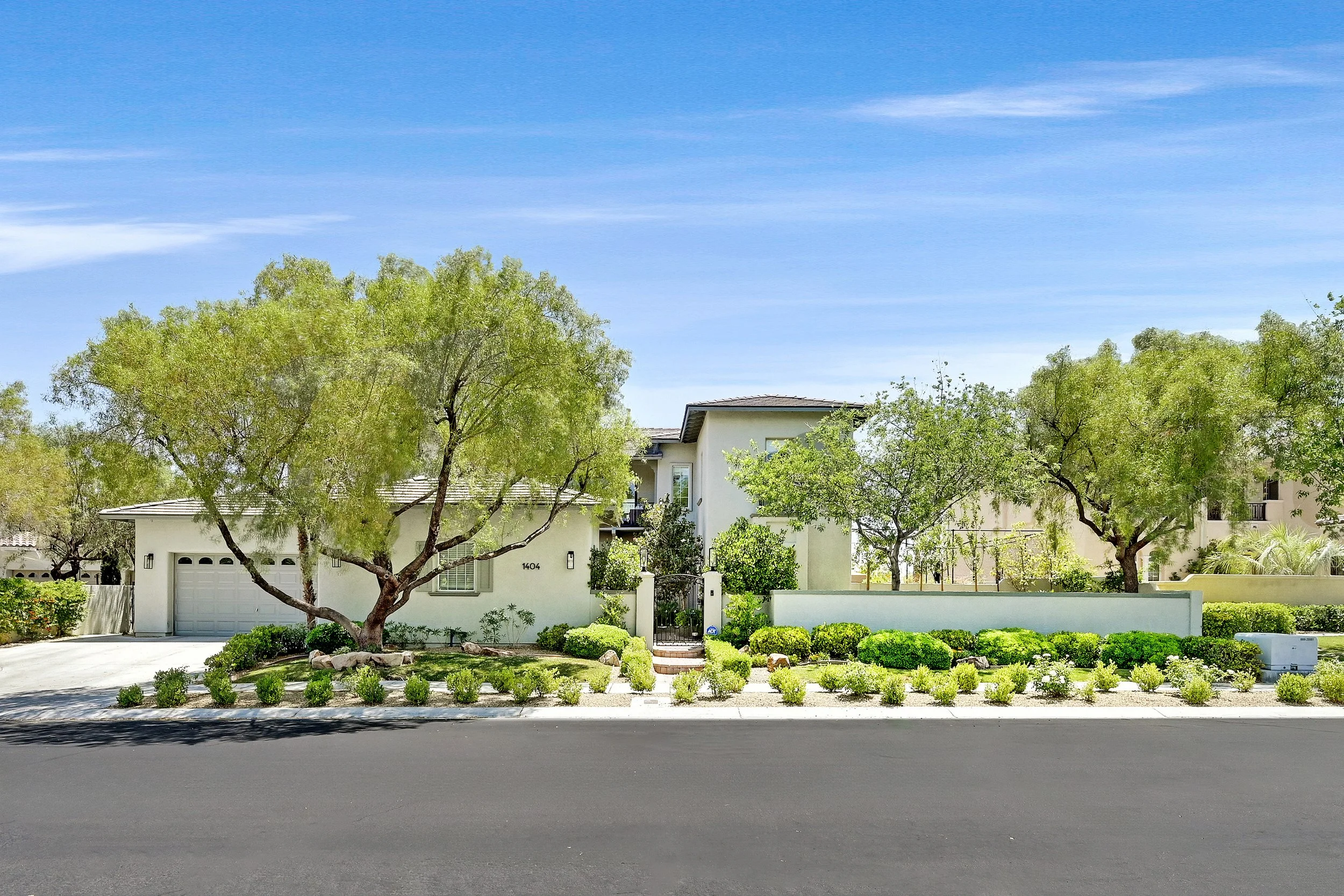
The luxury segment—homes priced at $1 million and above, including properties in The Ridges, Ascaya, MacDonald Highlands, Red Rock Country Club, and similar communities—shows the most dramatic imbalance. There's currently 8.5 months of inventory in this price range, more than double the supply available for homes under $500,000.
"There's over 1,000 active listings in Las Vegas currently over $1 million, and only 123 sales in the last month," Walkerlieb points out. "So when pricing your home as a seller, it's important to know which price range you're in. And when you're looking to purchase a home as a buyer in this market, it's important to know what kind of leverage you have based on the price point that you're targeting."
The math is stark: with over 1,000 listings and fewer than 130 monthly sales, sellers in this segment face meaningful competition. Buyers have time to be selective, room to negotiate, and the ability to walk away if terms don't meet their expectations.
What this means practically: if you're a buyer with the financial capacity to purchase in the luxury market, this is arguably the best environment Las Vegas has offered in years. You can take your time evaluating properties, request inspections and due diligence without pressure, negotiate on price and terms, and likely secure concessions that wouldn't have been available 18 months ago.
For sellers: the luxury market requires a different approach than mid-tier or entry-level properties. Staging, professional photography, targeted marketing, and above all, realistic pricing are non-negotiable. Overpricing a luxury home and waiting for the market to "catch up" is a strategy that results in extended time on market and eventual price reductions—often selling for less than if the property had been priced correctly from the start.
What's Driving the Imbalance?
Several factors are converging to create this seller-heavy market:
Pandemic-era construction boom: Las Vegas saw a surge of new construction during 2020-2022 as builders rushed to meet demand. That supply is now hitting the market as both new builds and recent purchases by buyers who are already looking to move.
Mortgage rate lock-in effect wearing off: Many homeowners who refinanced at 3 percent rates in 2020-2021 are now reaching a point where life circumstances (job changes, growing families, downsizing) are forcing moves despite the rate differential. They're reluctantly listing, adding to inventory.
Investor pullback: Institutional investors and individual real estate investors who were aggressively buying in 2021-2022 have largely stepped back, removing a significant source of demand that helped absorb inventory during the hot market.
Affordability erosion: According to Redfin senior economist Asad Khan, "Affordability within the housing market has eroded substantially over the past few years." Even with some recent price moderation, the combination of elevated prices and 7 percent mortgage rates has priced out a meaningful portion of potential buyers.
Is This a Crash? A Correction? Or Just Normalization?
Despite the dramatic 86.5 percent headline, Las Vegas isn't experiencing a housing crash. Prices have moderated—the median single-family home price sits around $470,000 as of recent data, down about 2 percent year-over-year—but we're not seeing the kind of precipitous declines that characterized 2008-2011.
Several factors are preventing a crash scenario:
Low distressed inventory: Foreclosures and short sales remain minimal. Most sellers are not in financial distress; they're simply adjusting to market reality.
Strong fundamentals: Las Vegas continues to see population growth, economic diversification beyond gaming, and major infrastructure investments (the Brightline high-speed rail, potential MLB stadium, continued resort development).
Equity cushion: Most homeowners who purchased before 2020 have substantial equity, meaning they're not underwater even if prices soften further.
What we're seeing is more accurately described as normalization—a return to market conditions where buyers have negotiating power, homes take longer to sell if overpriced, and sellers need to compete on price and condition rather than simply listing and waiting for multiple offers.
What This Means for Buyers
If you've been sitting on the sidelines waiting for better conditions, this is likely the best opportunity Las Vegas has offered since before the pandemic. But "buyer's market" doesn't mean every property is a bargain or that you should make lowball offers on everything you see.
For entry-level buyers (under $500,000): You have some negotiating room but shouldn't expect dramatic discounts. Focus on properties that have been listed for 30+ days, watch for price reductions, and don't be afraid to ask for concessions on repairs or closing costs. But also move decisively when you find the right property—well-priced homes in this segment still generate competing offers.
For mid-tier buyers ($500K-$1M): This is your sweet spot. You have genuine leverage, especially on properties that have been on market for 60+ days. Negotiate confidently, request thorough inspections, and don't accept the first counteroffer if it doesn't meet your needs. Sellers in this range are feeling the pressure of carrying costs and competition.
For luxury buyers ($1M+): You're in the strongest negotiating position Las Vegas has seen in years. Take your time, be selective, and don't hesitate to make offers 5-10 percent below asking on properties that have been listed for several months. Many luxury sellers are motivated, and the sheer volume of inventory means you can afford to walk away if terms don't work.
Across all price points: get pre-approved for financing, work with a local agent who understands neighborhood-specific dynamics, and remember that the best deals often go to buyers who can move quickly once they identify the right property—even in a buyer's market.
What This Means for Sellers
If you're planning to sell in the current Las Vegas market, success requires a clear-eyed assessment of where your property sits in the market hierarchy and what that means for pricing and strategy.
For all price ranges:
• Price based on recent comparables, not what your neighbor sold for in 2022 or what Zillow estimates
• Invest in presentation—professional photos, staging if appropriate, repairs that affect buyer perception
• Be prepared to negotiate on price, repairs, or closing costs
• Respond quickly to market feedback—if you're not getting showings within two weeks, your price is likely too high
Specific to your price range: If you're under $500,000, you're in the most favorable seller position but still need competitive pricing. Between $500,000 and $1 million, expect longer marketing times and be prepared to adjust strategy if the property isn't generating interest within 30 days. Above $1 million, understand you're competing with over 1,000 other listings for about 120 buyers per month—pricing aggressively from day one is essential.
As Walkerlieb emphasizes: "When pricing your home as a seller, it's important to know which price range you're in."
Looking Ahead: What to Expect in 2026
According to Redfin's Asad Khan, "The housing market is likely to remain in buyer's market territory for the foreseeable future, with sellers cutting prices or offering concessions to lure buyers." However, Khan also notes that "a modest improvement in housing affordability could bring some homebuyers off the sidelines in 2026, which could narrow the gap between homebuyers and sellers."
Several factors could shift market dynamics in the coming year:
Mortgage rates: If rates decline meaningfully below 6 percent, expect sidelined buyers to return quickly, potentially absorbing current inventory faster than anticipated.
Seasonal patterns: Spring typically brings increased buyer activity. Sellers who wait until March or April may face more competition from other listings but also a larger buyer pool.
Economic conditions: Job growth, wage increases, and overall economic confidence will determine whether buyers feel secure enough to make major purchases.
Inventory levels: If builders continue to slow new construction (as many are doing in response to market conditions), and if the wave of pandemic-era listings subsides, inventory could tighten again even without a surge in demand.
The key takeaway: Las Vegas is in a transition phase. The market isn't crashing, but it's no longer the seller's paradise it was in 2021-2022. Buyers have regained leverage, particularly at higher price points, while sellers need strategy and realistic pricing to succeed.
Questions About the Las Vegas Market?
Understanding where you fit in the current market—whether you're buying your first home in Henderson, selling a mid-tier property in Summerlin, or exploring luxury options in the guard-gated communities—requires local expertise and up-to-date market knowledge. The 86.5 percent headline tells one story, but the nuanced reality of different price segments, neighborhoods, and property types tells another.

About the Author
Zach WalkerLieb is a top Las Vegas real estate agent and Managing Partner of Willow Manor, one of the city’s leading luxury real estate teams. With hundreds of millions in closed sales, Zach brings a deep, practical understanding of the Las Vegas housing market, from high-end luxury to everyday residential realities. Beyond real estate, he serves as Chairman of the Board for Habitat for Humanity and as a board member of Keystone Corporation, giving him firsthand insight into housing policy, affordability, and long-term community development. Known for clear thinking, market truth, and local expertise, Zach writes to help buyers, sellers, and investors make confident, well-informed decisions in Las Vegas real estate.
Instagram | Facebook | X | TikTok | LinkedIn | YouTube